
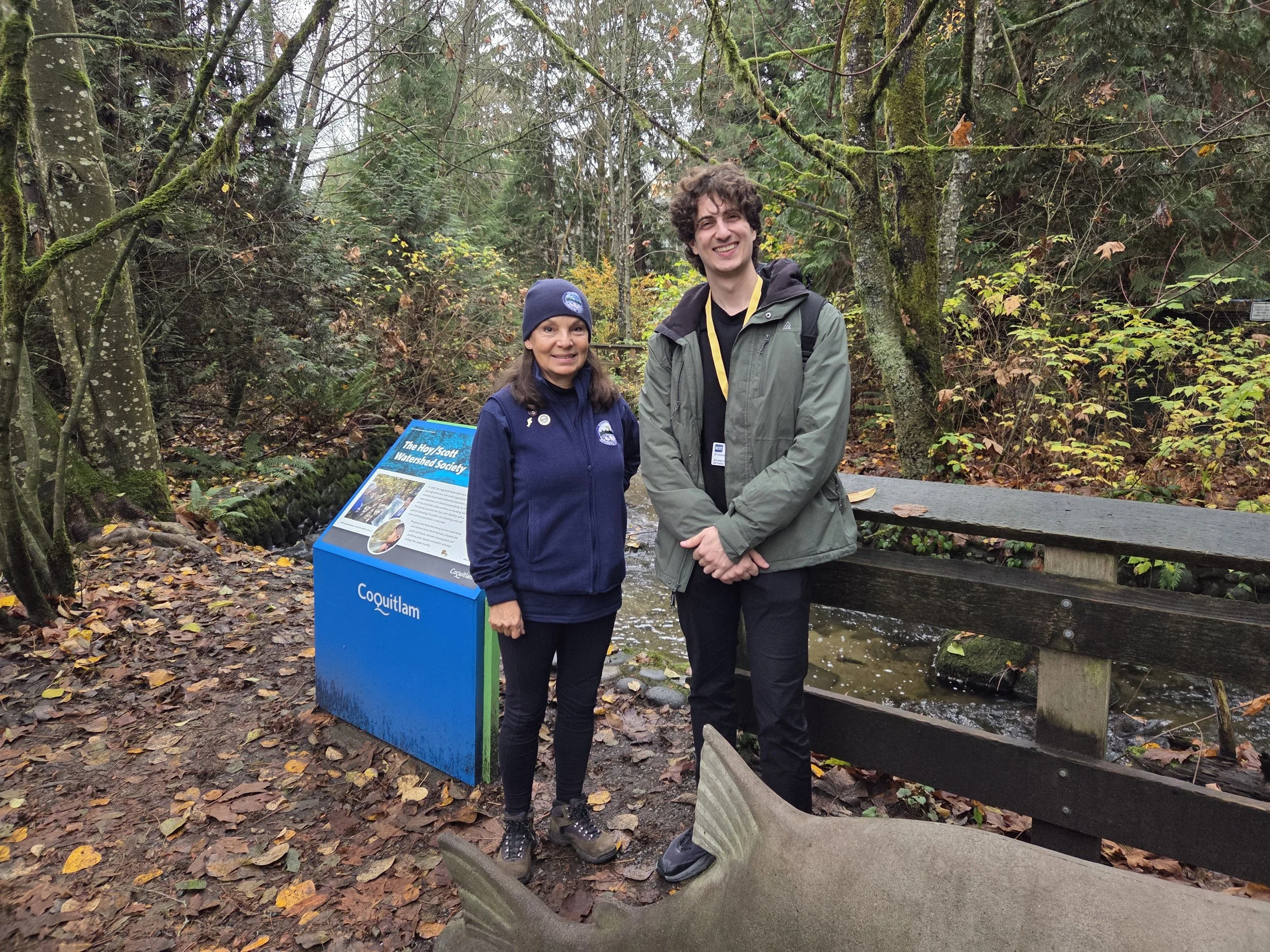
Robbin Whachell, Communications Director for Hoy/Scott Watershed Society stands by Hoy Creek with BCIT student journalist Ali Fallah on November 12 after an interview.
An interview with Hoy/Scott Watershed Society Communications Director Robbin Whachell highlights the volunteers, education and community vigilance that help protect Coquitlam's urban salmon habitat.
Just steps from Coquitlam City Hall, tucked into the forested trails of Hoy Creek Linear Park, an important piece of salmon conservation is happening right in the heart of the city.
For many people walking the trails, the creek is a peaceful green space. But behind the scenes, a dedicated team of volunteers is working throughout the year to support local salmon populations, care for young fish and educate the community about the importance of protecting our waterways.
In a recent interview with Ali Fallah, a BCIT student journalist producing For the Record for The Crow, Hoy/Scott Watershed Society Communications Director Robbin Whachell shared an inside look at the work taking place at Hoy Creek Hatchery.
A small hatchery with an important mission
Hoy Creek Hatchery is an educational hatchery operated by the Hoy/Scott Watershed Society. Its work focuses on helping maintain Coho salmon populations while providing opportunities for people, particularly young people, to learn about salmon and their surrounding environment.
The Society has approximately 70 members, including around 30 active volunteers. Saturdays are especially busy, with local high school students and university students from UBC and SFU often coming out to learn and lend a hand.
Volunteers take on a range of responsibilities, including feeding fish, checking water temperatures, monitoring the hatchery and observing the surrounding area for possible pollutants or other concerns.
The hatchery also has a daily feeder schedule, ensuring that its Coho salmon receive care every day of the week.
Following the salmon's journey home
Hoy and Scott Creeks support two main salmon species: Chum and Coho. Each fall, these salmon return to the streams where they were born to spawn.
The first salmon sighting this season was recorded on October 17. Rainfall plays an important role in their return, raising creek levels and allowing salmon to travel from larger waterways into the smaller streams where they began their lives.
During the spawning season, volunteers collect viable eggs from female salmon and milt from males for incubation at the hatchery. The process supports the natural reproductive cycle while helping to raise salmon for future release.
The Society also cares for Coho in its rearing pond, where the fish are kept for approximately 17 months and require daily feeding and monitoring.
During this time of year, the Society reminds visitors to stay out of the creek and keep dogs out of the water. Salmon eggs are developing in gravel nests known as redds, and disturbance can put them at risk.
Pollution: A threat that can happen in an instant
One of the most serious challenges facing urban streams is pollution.
Whachell recalled a major fish kill in 2019, when a chemical spill resulted in the loss of approximately half of the hatchery's fish.
More recently, the hatchery experienced another substantial fish kill after industrial bleach used during pressure washing at a nearby condominium entered the creek. The water was draining directly toward the stream, only a short distance away.
Environment and Climate Change Canada became involved in the investigation.
Whachell explained that pollution is not always easy to identify. Some contaminants are visible, changing clear water to a muddy or white appearance. Others, including chemicals such as bleach, may be difficult to detect and can be particularly dangerous.
The recent incident also demonstrated just how important community awareness can be.
A nearby resident walking his dog noticed the problem and contacted the appropriate authorities. That call allowed the Society and the City of Coquitlam to respond quickly, test the water and begin mitigation measures.
As Whachell emphasized during the interview, without that neighbour speaking up, the hatchery could have lost all of its fish.
Everyone has a role in protecting the creek
For Whachell, one of the Society's most important messages is that protecting local waterways is a shared responsibility.
People who live near Hoy and Scott Creeks have an important role to play. Noticing unusual water colour, suspicious dumping or other potential pollution and reporting it promptly can make a real difference.
The Society encourages everyone to adopt a simple message: If you see something, say something.
Storm drains are not disposal sites. Paint, bleach, chemicals and other substances entering storm drains can make their way into local creeks and harm fish and other aquatic life.
Our urban green spaces are valuable community assets, but they need our care and attention to remain healthy.
What success looks like
Success at Hoy Creek Hatchery is about more than the number of salmon raised.
It means seeing salmon survive the brood season, welcoming visitors to the Society's annual Salmon Come Home and Salmon Leave Home events, and having community members ask questions and become more interested in the natural world around them.
It also means seeing young volunteers return year after year.
Some begin volunteering at just 12 years old and continue into adulthood. Others discover an interest in salmon and conservation that eventually leads them toward careers in fisheries.
For Whachell, that lasting connection between people, nature and community is a significant part of the hatchery's success.
Hoy Creek Hatchery may be small, but its impact reaches well beyond the creek. Through conservation, education and the commitment of volunteers and neighbours, it helps ensure that future generations can continue to experience the return of salmon to the heart of Coquitlam.