
water quality monitoring

Volunteer Report Leads to Swift Investigation of Spill in Scott Creek

On April 29, a concerning discharge into Scott Creek was identified and quickly reported thanks to the vigilance of a Hoy/Scott Watershed Society volunteer.

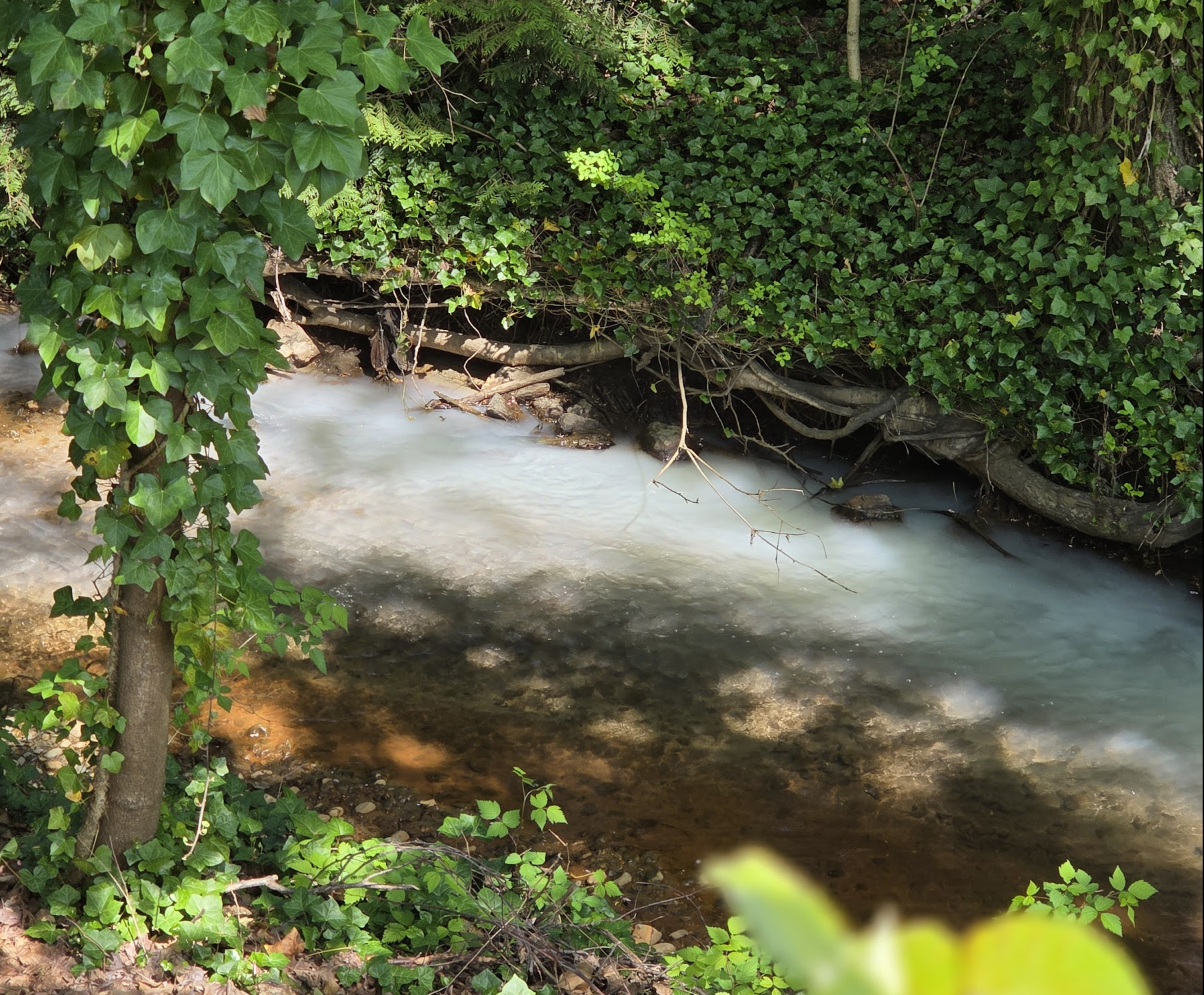
At approximately 12:00 p.m., a milky white substance was observed entering the creek from a stormwater outfall along Runnel Drive, just west of Lansdowne Drive. The spill was promptly reported to the City of Coquitlam, whose Environment Division responded quickly to investigate.

City Investigation Summary

City staff conducted on-site testing of the discharge, which showed a neutral pH of approximately 7.5 and low turbidity. While the appearance of the discharge was unusual, these initial results suggested that the substance was not immediately harmful to aquatic life.

An extensive investigation followed, with staff from both Environment and Public Works divisions surveying the surrounding catchment area. This included Burnside Place, Creekside Drive, Eagleridge Drive, and neighbourhoods north of Guildford Way along Lansdowne Drive. Crews looked for potential sources such as power washing runoff, paint discharge, or other contaminants, but no clear origin was identified.

During the investigation, the affected section of the creek began to return to normal clarity.
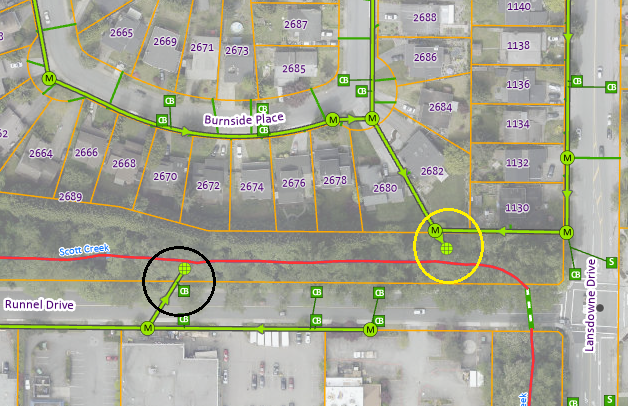
location of spills shown on city map

Additional Observation

Later in the afternoon, staff also observed a brief release of darker, turbid water entering Scott Creek from a second outfall further west along Runnel Drive, across from a local business. This discharge was short-lived, and the creek downstream remained clear.

Nearby contractors were observed completing roof debris clearing work. While no direct link was confirmed, City staff took the opportunity to provide education on proper practices—specifically, ensuring that wash water, sediment, and debris are kept out of storm drains, which flow directly into fish-bearing waterways like Scott Creek.

The City concluded its investigation at approximately 1:45 p.m.
The Importance of Community Reporting

This incident highlights the critical role that community members and volunteers play in protecting our local environment. Quick reporting allows for rapid response, assessment, and mitigation—helping to safeguard sensitive ecosystems and the species that depend on them.

The Hoy/Scott Watershed Society encourages anyone who observes unusual discharges, pollution, or environmental concerns in local waterways to report them immediately to the City. Learn more.

Together, through awareness and action, we can continue to protect and preserve the health of our creeks and watershed.

Water Quality Monitoring Underway at Hoy Creek

Kim Mayes, a volunteer, and director of the Society is leading up this project. She also provided the overview below.

Earlier this year the Hoy/Scott Watershed Society was approached by both Flowlink Environmental and the DFO to see if we were interested in capturing some basic water quality data in order to establish baseline water quality for Hoy Creek. This is something we had already been considering as stewards of Hoy Creek, so jumped on the opportunity to partner with Flowlink and start collecting.

Three sites were chosen along Hoy Creek to begin manually collecting in-situ data, with the support of Flowlink volunteers, who visit the creek weekly to test for and record the following:

  • Water Temperature

  • pH

  • Turbidity

  • Conductivity

At the time of testing, the current weather conditions are also recorded for reference. This is useful for helping us evaluate how seasonal trends influence the water quality parameters.

At two other locations along Hoy Creek, and with the support of the Departments of Fisheries and Ocean’s (DFO’s) Pacific Science Enterprise Center (PSEC) and their Community Steam Monitoring Project (CoSMo), we have now installed two temperature data loggers as well. This will help us record the data much more frequently (logs hourly), as well as more efficiently. The data loggers can store up to 5 years of data at a time and have a battery life of about 1 ½ years, so require little maintenance. Our aim is to collect the data 2-3 times per year (and when water levels of the creek permit), by removing from their current hidden locations and downloading the data via Bluetooth to a smartphone app. From there the data can be emailed to the DFO for analysis, as well as sharing with other nearby stream keepers.

We have plans to set up a more comprehensive Water Quality Monitoring Program in the near future, which will also include sampling and testing for the following, ideally on a monthly basis.

  • Alkalinity

  • Anions scan (nitrate, nitrite, phosphate, sulfate, chloride, fluoride, etc.)

  • Ammonia

  • E.coli

  • Total metals (full suite)

  • Dissolved oxygen

The overall goals for the program are to be able to identify emerging key water quality issues, allow us to be proactive in identifying spills/contamination sources, as well as raise public awareness, facilitate participation and education of our member volunteers.

We thank both Flowlink and CoSMo for supporting us with this work this far. However, in order to carry out our program initiatives indefinitely, we rely on the support of our volunteer members, and cannot do the important work we do without them.

Related article.