watershed restoration

Coho and Chum Broodstock Collection Complete

A beautiful Coho salmon specimen!

The Hoy/Scott Watershed Society is pleased to announce that our 2025 Chum and Coho broodstock collection at Hoy Creek Hatchery is now complete! This annual effort is a key part of sustaining healthy salmon populations in our local watershed, and we couldn’t have done it without the dedication and teamwork of our volunteers.

A heartfelt thank you to everyone who came out to learn, help, and support the process—whether in the creek, in the hatchery, or behind the scenes. We also extend our appreciation to our DFO Community Advisor, Eric, for his continued guidance and expertise.

A Chum salmon held up by HSWS director, Matt Watts after other volunteers assisted in broodstock capture using a net in Hoy Creek.

2025 Broodstock Summary

Chum

  • 17 pairs spawned

  • Estimated green egg total: 42,578

  • All trays have now been shocked, marking an important milestone in the early development phase.

Coho

  • 8 pairs spawned

  • Estimated green egg total: 18,381

These numbers reflect a successful season and the hard work of everyone involved in broodstock collection and spawning.

Hatchery manager, Tyler Storgaard with Coho eggs in a heath tray, ready for incubation.

Hatchery Leadership & Daily Operations

Hoy Creek Hatchery continues to operate under the leadership of hatchery manager, Tyler Storgaard, and assistant hatchery manager, Anne Woosnam, who guide our volunteers through each step of this important work.

A big thank you goes out to our daily feeders, who—on top of their regular feeding duties—are now:

  • Minding filters

  • Monitoring water temperature

  • Recording Accumulated Thermal Units (ATUs)

These tasks are essential for tracking egg development and ensuring optimal conditions in the hatchery.

Salmon season may be winding down in the creek, but inside Hoy Creek Hatchery, salmon are hard at work—and so are we.

Thank you to everyone helping us protect and restore our local watershed. Stay tuned for updates as our eggs develop and hatch in the months ahead!

Chum salmon hanging in Hoy Creek Hatchery ready for egg and milt take.

Tyler and Amy performing an egg take at Hoy Creek Hatchery.

Buckets of salmon eggs ready for incubation!

Invasive Species Work Integral for a Healthy Riparian

Adela and Anne seen near a hedge of Smallflower touch-me-not on Hoy Trail.

This summer, the Hoy/Scott Watershed Society continued its important work tackling invasive plant species in Hoy Creek Linear Park — efforts led by our dedicated volunteers Anne Woosnam and Robbin Whachell. Invasive plants such as Himalayan balsam and Smallflower touch-me-not can quickly spread, outcompeting native plants and altering the habitat that salmon and other wildlife rely on. With the help of our volunteers and community partners, we’ve made great strides in reclaiming space for native species to thrive.

June: Smallflower Touch-Me-Not

Our summer work began in June with a focus on Smallflower touch-me-not (Impatiens parviflora), an invasive balsam species we first encountered along Hoy Trail last year. Despite last year’s efforts, it was clear how aggressively this plant can return — spreading quickly through the same areas.

Thanks to the persistence of Anne, Adela, and Robbin, we were able to pull large amounts from the trail edges before they could set seed. Early intervention is key, and each pull helps prevent further spread. (Learn more about this invasive balsam here: BC Invasives – Smallflower Touch-Me-Not)

July: Himalayan Balsam

Anne helps fill bags and the wagon with tall Himalayan balsam along Hoy Trail.

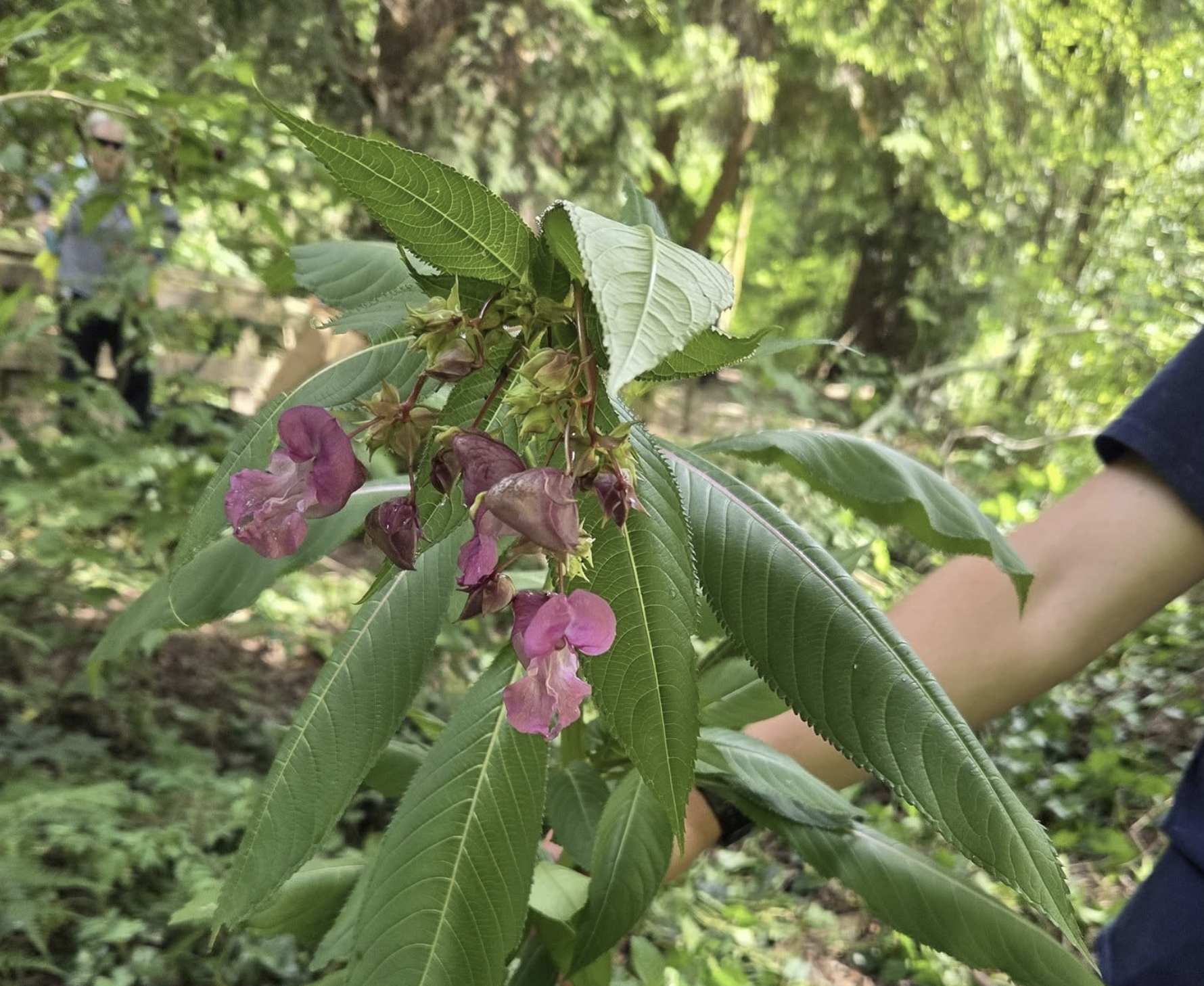
End of June and into July, attention turned to Himalayan balsam (Impatiens glandulifera), another invasive species that thrives in moist riparian areas like Hoy Creek. With its pink flowers and explosive seed pods, it may look beautiful, but it can quickly dominate streambanks and crowd out native plants.

This pull was a true community effort: together we filled nine large bags of balsam, with even more left in piles for collection. Volunteers included Anne, Tyler, Dylan, Matt, Rhyann, Lucas, and Robbin — along with Alex from Broombusters Coquitlam, who brought energy and expertise. A big thank-you as well to residents Jen and David, who jumped in after seeing us at work. That’s community stewardship in action!

We are grateful to the City of Coquitlam Natural Areas team for coordinating pickup, and to Broombusters Coquitlam for donating collection bags to support our efforts.

Himalayan balsam (Impatiens glandulifera)

Why It Matters

By removing invasive plants, we’re giving native species — the plants that provide food and shelter for insects, birds, and salmon — a better chance to flourish. Every bag pulled means less seed dispersal next season, and a healthier creekside ecosystem for years to come.

Thank You Volunteers

A huge thank you to Anne and Robbin for leading this summer’s invasive species pulls, and to every volunteer and community member who joined in. Your hands-on work is helping protect Hoy Creek and its surrounding habitat.

Together, we’re building a stronger, healthier watershed.

Facebook Photo Album